Author: Elif Shafak
What makes The Island of Missing Trees so extraordinary is that the fig tree is not simply a literary device or a symbol. It has its own voice, memories, and wisdom. In other words, every now and then, a book comes along that floors me. This might be the book that floored me forever, because I do not remember when any book made me feel so delighted as this one. When I enjoy a book, I usually can’t let it go, and while not letting go, I feel annoyed that I will read the book but can’t help myself nevertheless. In this case, I had to absorb what I was reading to an extent that I was unable to read a lot because it was so meaningful and beautiful that, for the first time ever, I savoured the book and took a long time to finish it. That never normally happens.
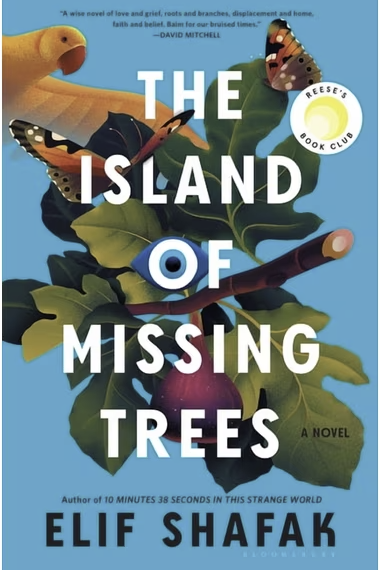
The book is beautifully written, deeply moving, and full of compassion, not only for people but also for the natural world. The novel tells the story of Kostas, a Greek Cypriot, and Defne, a Turkish Cypriot, who fall in love in Cyprus during a period of political and ethnic division. Their relationship unfolds against the backdrop of the conflict that tears the island apart, leaving behind loss, displacement, and memories that are too painful to confront. Years later, their daughter Ada, growing up in London, struggles to understand her family’s history and the silences surrounding it, so the story moves between different periods and places, gradually revealing how the past continues to shape the present. It explores love, grief, identity, belonging, and the consequences of conflict, not only for those who experience it directly but also for the generations that follow. It also shows how meaningless wars are and that politics only divides people.
However, what makes this novel truly extraordinary is one of its narrators: a fig tree. I have always been a bit of a tree hugger. I love trees, and I have always felt that they deserve far more respect than we give them, and that they provide so much benefit to the planet and comfort. I love looking outside and seeing trees, or just sitting outside and watching branches dance with the wind. I also wrote before about ecofeminism and its arguments in favour of protecting nature. Perhaps that is why I found the fig tree’s narration so incredibly moving. The tree witnesses human happiness and suffering, remembers what people would rather forget, and tells its own story of survival, displacement, and belonging.
Through the fig tree, Shafak reminds us that trees are living beings with histories of their own. They exist alongside us, witnessing generations come and go, surviving wars, changing landscapes, and human destruction. They provide shelter and sustain other forms of life, yet we so often treat them as objects or resources rather than as an essential part of the world we inhabit. I absolutely loved the respect this book shows to trees and nature more broadly. The author gave trees a voice, allowing them to observe humanity, sometimes with greater wisdom than the humans themselves. The fig tree is a character in its own right, with memories, attachments, and a perspective that challenges our human tendency to place ourselves at the centre of everything. The novel also draws striking parallels between human displacement and the uprooting of trees: both carry histories, both struggle to adapt to unfamiliar surroundings, and both remain connected to places they have left behind. The idea that a tree can carry memory across borders is particularly poignant in a story about migration, identity, and the enduring consequences of conflict.
Shafak does not portray the natural world as separate from human history but portrays nature through resilience, continuity, and renewal, and as a witness to humanity. Shafak manages to address painful subjects without losing the beauty and tenderness of the story. The characters are complex, the historical setting is compelling, and the narrative moves effortlessly between personal memories and larger questions about history, culture, and belonging. The story unfolds in a dual way, through human storytelling, and then the same story is told by a fig tree who saw more and saw things differently, which was incredibly compelling. When humans wonder what happened, the tree knows because it was there, always.
There is sadness in this novel, certainly, but there is also extraordinary warmth. It is a story about the things we lose, the things we carry with us, and the connections that survive even when everything around us changes. For me, however, the fig tree remains the most unforgettable character. I loved its observations, its memories, and the gentle reminder that humans are not the only beings whose lives and histories matter. I finished this book feeling that I had read something genuinely special: it made me think about history, the consequences of hatred, and the importance of remembering, but it also reinforced something I have always believed: that trees deserve our admiration, protection, and respect. If you love beautifully written historical fiction, stories about family and belonging, or simply have an appreciation for the natural world, I cannot recommend this novel highly enough.
One of my favourite books of all time, which I will not easily forget.
Thank you for reading!